


Robotic Knee Replacement
Robotic knee replacement takes the proven foundation of conventional surgery and adds a layer of technology-driven precision that conventional instruments cannot match alone. Before the procedure begins, a CT scan is used to create a detailed three-dimensional map of the patient's knee. The surgeon plans the entire operation digitally — selecting implant size,
positioning, and bone cut depths based on the individual patient's unique anatomy rather than generalised anatomical norms.
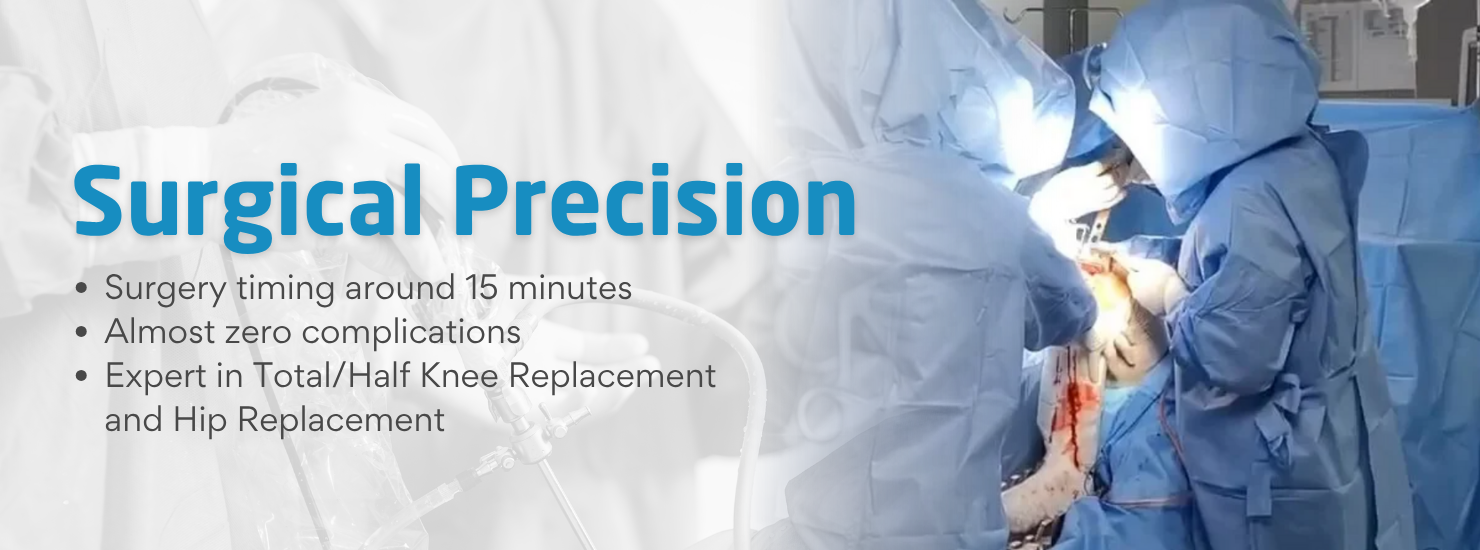
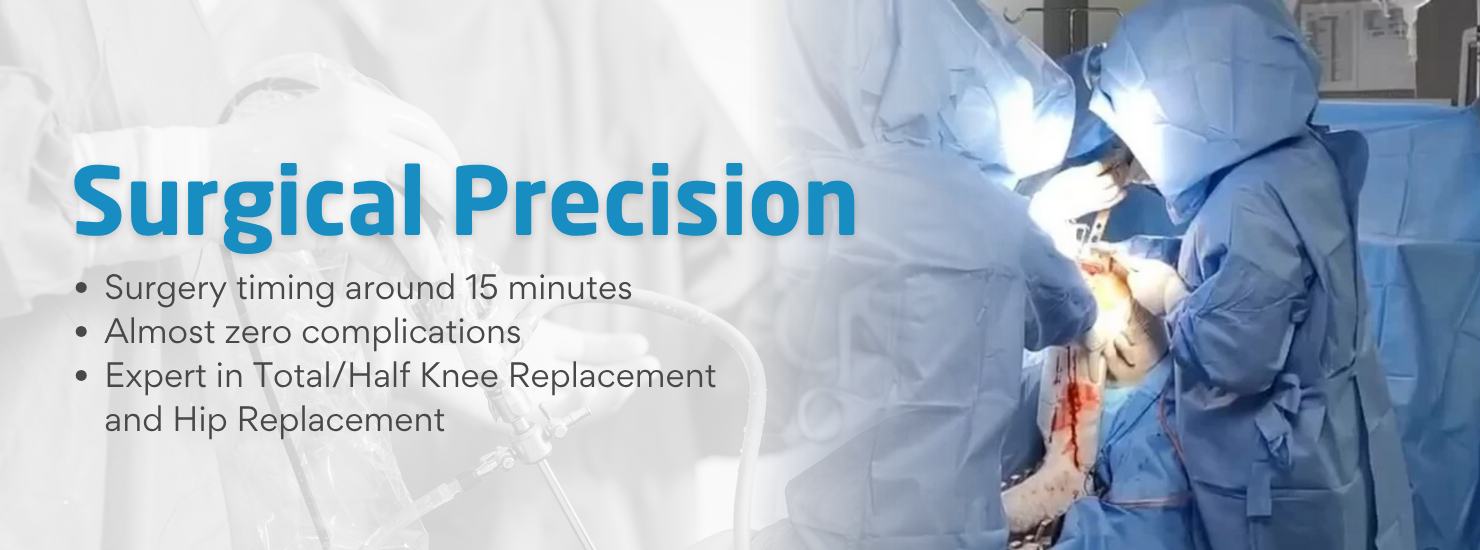
In the operating theatre, a robotic arm assists the surgeon in executing the pre-planned bone cuts with sub-millimetre accuracy. The system continuously tracks the patient's anatomy in real time and will not allow cuts to deviate from the surgical plan. Crucially, the surgeon remains in complete control at all times — the robot is a precision instrument, not an autonomous operator.
The result is implant positioning that is consistently more accurate, more personalised, and more closely aligned with the patient's natural joint mechanics — translating into a knee that moves more naturally, recovers faster, and may last longer.
| Factor | Standard Knee Replacement | Robotic Knee Replacement |
|---|---|---|
| Surgical Planning | Based on X-rays and the surgeon’s intraoperative judgment | Pre-operative 3D CT mapping creates a personalised plan of your knee |
| Implant Alignment | Manual guides and the surgeon’s experience determine alignment | Robotic arm provides real-time guidance — accurate to sub-millimetre precision |
| Bone Removal | Surgeon-guided cuts using mechanical instruments | Robotic system controls the cutting boundary — prevents any unplanned bone removal |
| Tissue Disruption | Standard incision with moderate surrounding tissue involvement | Minimally invasive; robotic precision reduces damage to surrounding soft tissue |
| Personalisation | Standardised approach based on general anatomical principles | Every surgical plan is built around the individual patient’s exact anatomy |
| Recovery Speed | Typically, 3–6 months for full recovery | Faster early recovery — many patients walk within 24 hrs; less post-op pain |
| Long-term Outcomes | Excellent — proven over decades of widespread use | Growing evidence of superior implant longevity due to precise alignment |
| Cost | Generally lower — standard technology and technique | Higher — reflects advanced robotics, 3D planning, and personalised precision |
| Availability | Widely available at most orthopaedic centres | Specialist centres — available with Dr. Manu Sharma, Surat |
Which One is Right for You?
Standard knee replacement is an excellent, proven option — and for many patients, it remains the most appropriate choice. Robotic knee replacement offers added precision and personalisation, making it particularly valuable for patients with complex anatomy, higher activity
expectations, or those who want the most advanced technology available for their procedure. The right choice is not determined by technology preference alone — it depends on your specific anatomy, deformity, lifestyle goals, and the clinical assessment of your surgeon. Dr. Manu Sharma offers both standard and robotic-assisted knee replacement in Surat, and will guide you to the approach that best fits your individual needs.